Showing posts with label Forest. Show all posts

Tuesday, August 6, 2013

Christopher Deaderick talked about regrowth following Mountain Pine Beetle infestation in conifer forests

For the past decade, Mountain Pine beetles (MPB) have invaded millions of hectares of forest in Colorado and Wyoming, causing extensive conifer mortality.

While it is commonly believed that growth rates of subcanopy trees increase following removal of overstory trees, limited empirical data exist to confirm this.

Tree ring data can provide insights into such growth releases, as well as chronological occurrence of past climate and disturbance events and the severity and frequency of these events.

Christopher Deaderick, majoring in Biology and Environment and Natural Resources (ENR), was selected for the 2013 McNair Scholar. His research focused on examining the magnitude and timing of growth release of subcanopy trees following MPB-induced overstory mortality, with the objective of estimating the differences in growth release among cohorts (vertical tree canopy layers) and among tree species.


Christopher presented his research in the 21st annual McNair Scholars Research Symposium in UW Wyoming Union on July 29, 2013. McNair Scholars program prepares undergraduate students to pursue graduate studies by providing opportunities to define goals, engage in research, and develop the skills and student/faculty mentor relationships critical to success at the doctoral level.”

Dr. Daniel Tinker (Associate Professor, Botany Department) was Christopher’s research mentor. Dr. Tinker’s research focuses on forest & fire ecology.  For further information visit his lab’s website.

--- Contributed by Christopher Deaderick

Saturday, August 3, 2013

Adam Grasmick presents his Research Work in the 21st Annual McNair Scholars Research Symposium

Adam Grasmick, Botany major, described his research on leaf anatomy and morphology of Tillandsia complanata, a widespread epiphytic species from the Bromeliaceae. Very little is known about leaf structure differences in bromeliads in relation to light exposure, and his research is one of the first studies to address this question.


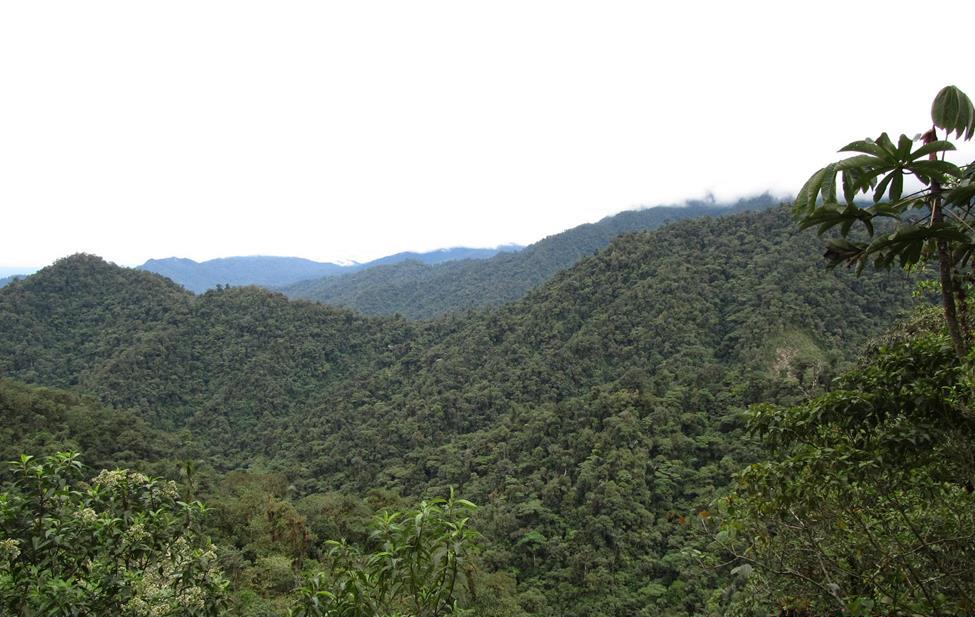
Bromeliads are ecologically important epiphytic and terrestrial monocots in the New World tropics and subtropics and play an important role in sustaining the biodiversity. These specimens were collected from the Cloud forest in the Napo Province, Ecuador.


Adam’s presentation was one of the twelve talks delivered in the 21st annual McNair Scholars Research Symposium in UW Wyoming Union on Monday, July 29, 2013. McNair Scholars program prepares undergraduate students “to pursue graduate studies by providing opportunities to define goals, engage in research, and develop the skills and student/faculty mentor relationships critical to success at the doctoral level.”  Dr. Greg Brown (Chair, Botany Department) is serving as Adam’s mentor for this research project.

--- Contributed by Adam Grasmick

Monday, November 21, 2011

Public Seminar in Jackson, WY on bark beetles, climate change and forest pestilence

Drs. Matt Ayres (Professor of Biology at Dartmouth College), Brent Ewers (Botany), and Dan Tinker (Botany) will also jointly offer a public talk on bark beetles, climate change and forest pestilence in Jackson WY on Thursday, December 1 at the National Museum of Wildlife Art, 6:30-8:30, with doors opening at 6:00 pm.

Special seminar on "Climate, population dynamics, and forest pestilence"

--Thomas Morrison


Matt Ayres (Professor of Biology at Dartmouth College) will be giving a seminar at 4 pm on Wednesday, November 30 in the Berry Center, room 138, in a special event jointly supported by Environment and Natural Resources, the Zoo-Phys Department and Botany Department.

The title of Matt’s seminar is "Climate, population dynamics, and forest pestilence." The seminar will be preceded by a reception with light refreshments in the Berry Center at 3:30 pm.

Please email me know if you’re interested in meeting with Matt either Wednesday morning (Nov 30) or Friday afternoon (Dec 2).

Matt has a diverse research program, generally exploring spatiotemporal variation in the abundance of forest insects, especially those that are sometimes recognized as pests. Study systems include bark beetles, Lepidoptera, wood wasps, scale insects, phoretic mites, and fungi. More info on his research program can be found here.

Matt is very engaging (see picture of him with Spanish magician/wizard on his homepage) and has broad scientific interests. I think you’d enjoy meeting with him (and vice versa) if you can spare the time.

Matt is also keen to go hiking in the Snowies on Saturday (Dec 3) to see some forest-beetle interactions first hand. Let me know if you might be interested in joining.

Sunday, November 20, 2011

Dr. Dan Tinker presents at the 2011 Future Forests Summit

Dr. Tinker was by invited by the Colorado Bark Beetle Cooperative (CBBC) to talk about the ongoing bark beetle epidemic as part of the Future Forests Summit at the Colorado Mountain College's Breckenridge campus.

CBBC is "a coalition of officials from agencies, organizations, educational institutions and more who are working to address the ecology of lodgepole pine forests and their future (Kurbjun, 2011, Summit Daily News)."

Complete information about Dr. Tinker's presentation can be found at Summit Daily newspaper's website.

Visit the Tinker Lab for Forest & Fire Ecology website to learn about Dr. Tinker's research.